Find the Perfect Trees for Your Landscaping Projects
Find the Perfect Trees for Your Landscaping Projects
If you don't see the tree you would like below, give us a call to see what other types of trees are available!
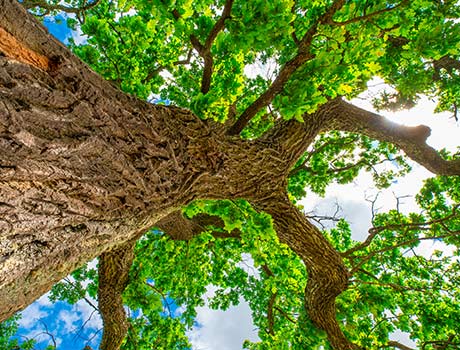
Live Oak
Tree Description:
A large, stately tree, commonly to 50 feet tall with a short, stout trunk of 4 feet or more in diameter, dividing into several large, twisting limbs that form a low, dense crown that can spread more than 100 feet, the limbs often touching the ground in open-grown settings.
Range/Site Description:
Occurs on well-drained soils in the southern coastal plain, from Virginia through the Atlantic and Gulf states and into Texas, west to the Balcones Escarpment and south to Hidalgo county. Widely planted as a landscape tree in Texas.
Leaf:
Simple, alternate, evergreen, thick, and leathery; oval, oblong, or elliptical in shape, 2" to 4" long and 0.5" to 2" wide; smooth, glossy, and dark green above, pale and silvery white beneath. Leaves can sometimes be toothed, especially towards the tip.
Flower:
Borne in spring on the same tree, the male flowers on catkins up to 3" long, the female flowers on a peduncle 1" to 3" long in the leaf axils.
Fruit:
An acorn, requiring one year to mature, about 1" long and 0.5" in diameter, oblong, dark brown and shiny, set about one-half its length in a gray, downy cup that is borne on a long stem or peduncle.
Bark:
Dark brown, rough, and furrowed on trunk and large branches, developing very thick, interlacing ridges and deep furrows on older trees. Some specimens have thinner, paler, scaly bark.
Wood:
Very heavy, hard, strong and tough, light brown with nearly white, thin sapwood; formerly used in shipbuilding and for wagon wheel hubs. Now primarily sold as a landscape tree in the nursery trade.
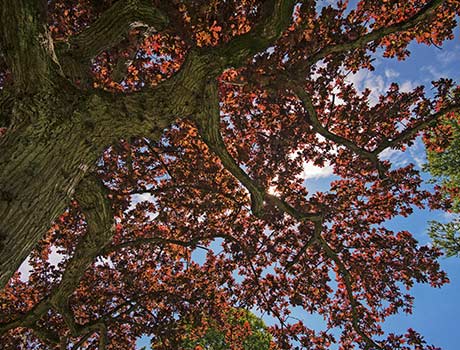
Texas Red Oak
Tree Description:
Usually a medium-sized tree to 35 feet tall with one or more trunks 10" in diameter but can reach heights of 70 feet on fertile sites.
Range/Site Description:
Found on dry, limestone hills and ridges, and sometimes in the more fertile soils at their base, in Central Texas west to the Edwards Plateau.
Leaf:
Simple, alternate, 3" to 5" long and 2.5" to 3" wide, widest above the middle, divided into 5 to 7 bristle-tipped lobes, with the terminal lobe often 3-lobed and the sinuses usually deep. Leaves have a slender petiole about 1" long, are dark green and shiny above, paler below, and turn deep shades of red in the fall.
Flower:
Male and female flowers borne separately in spring on the same tree; male catkins 1.5" to 3.5" long, yellowish-green, female flowers reddish, about 0.5" long, usually solitary.
Fruit:
An acorn, requiring two years to mature, usually single or in pairs, short-stalked, reddish-brown, pubescent, and often streaked with dark lines; measuring 0.25" to 0.75" long, ovoid, and set in a cup that covers one-quarter to one-half of the fruit.
Bark:
Dark gray to black, smooth at first, then very rough with deep fissures and ridges.
Wood:
Used for fuelwood and posts. Also used as a landscape tree in Central Texas.
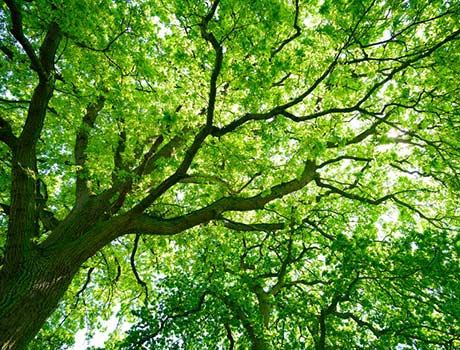
Monterey Oak
Tree Description:
A medium-sized oak to 40 feet tall and a trunk to 2 feet in diameter, with a broad, rounded crown.
Range/Site Description:
Naturally occurring only in one known U.S. population, near the Devil's River in Val Verde county, but more common in Mexico. Now planted widely as a landscape tree.
Leaf:
Simple, alternate, 2" to 5" long, highly variable, but often with several shallow lobes or teeth towards the tip. Leaves are thick, leathery, and semi-evergreen, with distinct raised veins on the yellowish underside. New leaves in spring are peach-colored and in colder climates the leaves are late-deciduous and turn yellow-brown.
Flower:
Male and female flowers borne in spring on the same tree, the male flowers on catkins up to 4" long, the female flowers less conspicuous.
Fruit:
An acorn, maturing in one year, up to 1" long and enclosed one-half by the acorn cup.
Bark:
Dark to light gray, developing scales and flaky plates, then shallow fissures on older trunks.
Wood:
Primarily used as a landscape tree in the nursery trade, and often sold as 'Monterrey oak.
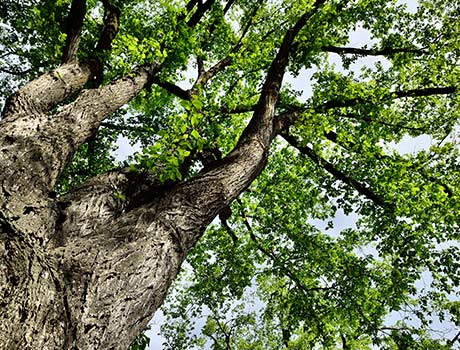
Burr Oak
Tree Description:
A large tree of the prairies reaching a height of 80 feet or more and a trunk diameter of 5 feet, with a short body and heavy branches that form an open, spreading crown of dark green foliage.
Range/Site Description:
Occurs on limestone soils in Central Texas as far west as Tom Green county, often on rich bottomlands along streams or hillsides and banks along spring-fed rivers. Also planted widely as a landscape tree throughout Texas.
Leaf:
Simple, alternate, 6" to 12" long and 3" to 6" wide, with 5 to 9 highly variable lobes that lack bristle-tips; lobes are divided by at least one pair of very deep sinuses, and the upper one-third of the leaf typically has a roughly-toothed or weakly-lobed margin.
Flower:
Separate male and female flowers appear in spring on the same tree. Male flowers borne on a yellowish catkin 4" to 6" long; inconspicuous female flowers reddish in color.
Fruit:
An acorn, requiring a single season to mature, 1" to 2" long, ovoid, set deeply in a mossy-fringed cup that gives the species its common name.
Bark:
Twigs and branches are thick, developing conspicuous corky ridges after the second year; bark is light gray, rough and breaks into small, narrow flakes on young trees, then develops very thick bark with deep fissures and narrow plates.
Wood:
Heavy, hard, strong, tough and durable; used for lumber, crossties, and fuelwood.
Cedar Elm
Tree Description:
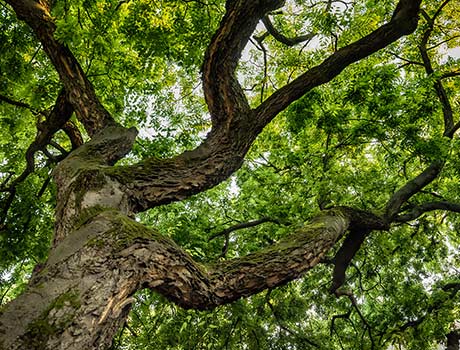
A large tree to 75 feet tall with a tall straight trunk 2 to 3 feet in diameter and stiff branches that form a narrow, oblong crown.
Range/Site Description:
The most common elm tree in Texas, distributed widely in East, South, and Central Texas. Most often found near streams, in solid stands on flatwoods near rivers, or on dry limestone hills. Also planted widely as a landscape tree.
Leaf:
Alternate, simple, 1" to 2.5" long and 0.75" to 1" wide, oval to elliptical in shape, finely-toothed or sometimes double-toothed along the margin, and blunt at the tip. The upper surface is dark green, shiny, and rough, while the lower surface and petiole are pubescent. Twigs sometimes have thin, corky "wings" and the leaves can turn gold to orange-red in the fall.
Flower:
Appear in late summer or autumn as hairy, short-stalked clusters in the leaf axils.
Fruit:
An oval "samara," 0.25" to 0.5" long, the seed centered in the middle of the wing, deeply notched at the tip and hairy all over, especially along the margin. Seeds are borne in the fall, which distinguishes this species from the other native elms.
Bark:
Light brown to gray, with flattened ridges that break into thin, loose, flaky scales.
Wood:
Reddish-brown, brittle, with a thick layer of light-colored sapwood. The wood is sometimes used to manufacture wheel hubs, furniture, and fencing. Commonly sold in the nursery trade as a landscape tree.